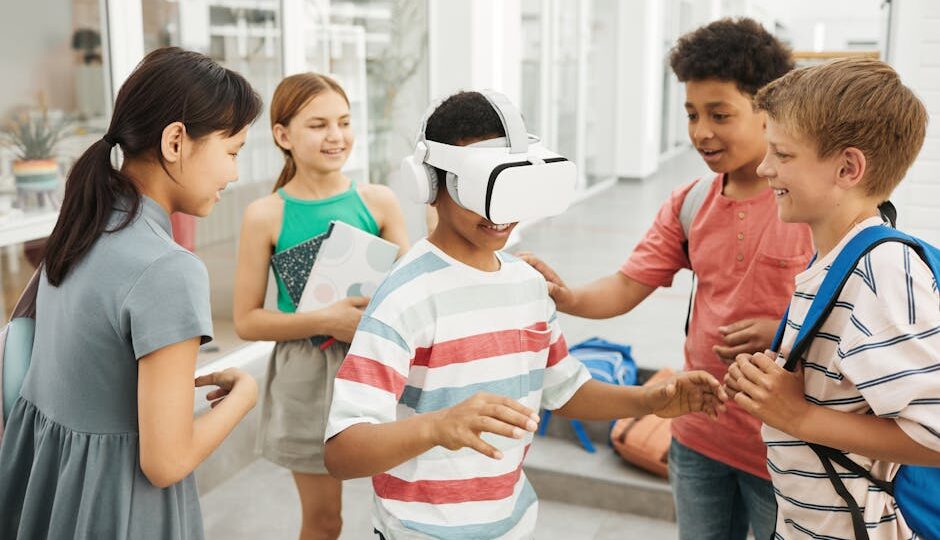
Transforming Classrooms into Interactive Worlds
Virtual Reality (VR) and Augmented Reality (AR) have dramatically altered the landscape of education as we know it. By 2026, these tools have shifted from being futuristic fantasies to essential elements in classrooms across the globe. Imagine a history lesson where students step into ancient Rome or a biology class where they explore the human body at a molecular level. This isn’t a dream—it’s a reality unfolding today in schools from Tokyo to Toronto.
Research shows that students retain up to 80% more information when they are engaged in immersive environments. Combining visual, auditory, and kinesthetic learning styles, VR and AR tailor educational experiences to meet the diverse needs of learners. It’s not just about making learning fun; it’s about making it effective.
Bridging the Global Learning Divide
One of the most exciting aspects of VR and AR in education is their potential to democratize learning. In regions where resources are scarce, such as rural areas in Africa or understaffed schools in inner-city America, VR and AR can provide access to quality educational content. A VR headset in a small town classroom can open a portal to the world’s best museums, science labs, and historical sites.
Moreover, AR applications on smartphones and tablets can overlay information on physical objects, transforming a simple classroom into an interactive learning hub. In countries like India, where smartphone penetration is high, AR educational apps are becoming increasingly popular, making learning accessible anytime and anywhere.
Inspiring New Ways to Engage and Motivate Students
Traditional textbooks and lectures often fail to engage students fully. However, VR and AR turn passive learning into an active experience. For instance, in a physics class, students can simulate complex experiments without the constraints of physical lab equipment. In art, students can virtually visit the Louvre to study the brushstrokes of the masters up close.
Teachers report that students are more motivated and focused during VR/AR lessons. For example, in a 2025 study conducted by Stanford University, teachers noted a 70% increase in class participation when VR was used to teach difficult concepts.
Developing Essential Skills for the Future
As the world continues to evolve, so does the skill set students need to succeed. VR and AR applications are uniquely positioned to help develop critical 21st-century skills, such as problem-solving, critical thinking, and collaboration. In New York, a pilot program uses VR to simulate real-world business scenarios, allowing students to practice negotiation and decision-making skills in a risk-free environment.
Furthermore, coding and digital literacy will be as fundamental as reading and math moving forward. VR and AR not only teach these skills but also inspire students to create their own virtual worlds, fostering creativity and technological fluency.
Overcoming Challenges and Moving Forward
Admittedly, the implementation of VR and AR in education has not been without its hurdles. High costs and the need for significant bandwidth and technological infrastructure have posed challenges. However, the rapid advancement of technology and a decrease in hardware costs are making these tools more accessible. For example, in 2026, the average cost of a VR headset has decreased by 50% from 2023, making it more feasible for schools to adopt this technology.
Moreover, partnerships between tech companies and educational institutions are growing. Tech giants like Google and Microsoft are working with schools to provide affordable VR and AR solutions, ensuring that the future of education is inclusive.
Practical Takeaways for Educators and Administrators
As VR and AR continue to revolutionize education, educators and administrators have a unique opportunity to harness these technologies. Start by integrating VR and AR into lesson plans to provide immersive and engaging learning experiences. Consider collaborating with tech companies to access resources and training for staff. Additionally, involve students in the creation of VR content to foster a deeper connection with the material.
The bottom line is that VR and AR are not just trends—they are transformative tools that are reshaping education. By embracing these technologies, educators can prepare students for a future where the only limit is their imagination.